
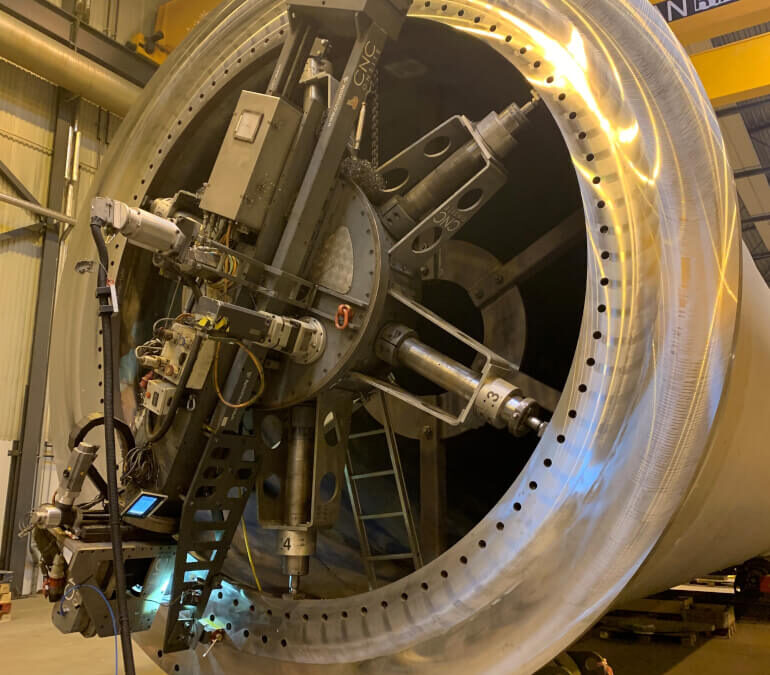
Ultra-stable CNC finishing strategies have become indispensable in the manufacturing of thermal-resistant turbine bore flanges, a class of components engineered to withstand extreme temperature fluctuations, high rotational loads, and aggressive operating environments inside advanced aerospace propulsion systems. As modern turbines push toward higher combustion temperatures and more compact structural designs, the bore flange has evolved into one of the most critical interfaces for ensuring alignment, sealing capability, and load transfer across multiple stages of a turbine assembly. Its geometry—which often includes intricate blend radii, fine sealing surfaces, precision bores, and tight angular transitions—requires an exceptionally stable finishing process that minimizes vibration, maintains thermal consistency, and ensures micron-level accuracy. Traditional machining methods that rely on manual adjustments or conventional milling cycles are no longer adequate for meeting the stringent demands of next-generation heat-resistant alloys such as Inconel 718, Haynes 282, MAR-M superalloys, or titanium aluminides. These materials exhibit high strength at elevated temperatures, low thermal conductivity, and significant work-hardening characteristics. Ultra-stable CNC finishing, therefore, integrates optimized toolpath design, robust fixturing, harmonic-controlled spindle technologies, and advanced cutting parameters to achieve flawless, repeatable performance under demanding thermal and mechanical constraints. With industry certification increasingly tied to surface integrity, dimensional stability, and fatigue resistance, mastering these finishing strategies is essential for aerospace manufacturers seeking long-term reliability and global competitiveness.
A core pillar of ultra-stable finishing lies in the ability to eliminate chatter and ensure constant tool engagement during the machining of thermal-resistant bore flange surfaces. Because these components operate under cyclical loading and high-heat conditions, even microscopic irregularities can lead to premature wear, thermal distortion, or structural discontinuities that compromise overall turbine performance. CNC finishing must therefore prioritize vibration suppression through multi-dimensional techniques: refined spindle speed mapping, dynamic tool balancing, and real-time harmonic feedback control. Advanced CNC machines now incorporate intelligent vibration monitoring systems that modulate feed rates, spindle speeds, and engagement angles to maintain tool stability throughout the entire finishing cycle. This is especially important in areas like bore chamfers, flange shoulders, and sealing transitions, where the tool often must navigate tight semi-round features and extended axial depths without sacrificing surface smoothness. Additionally, ultra-stable finishing adopts precision stepover patterns such as constant scallop-height finishing, blend-region feathering, and adaptive smoothing toolpaths that distribute cutting loads evenly across the surface. These toolpaths allow the machine to maintain uniform pressure and chip thickness, ensuring that every section of the bore flange—whether linear, angled, or curved—receives consistent finishing quality. By focusing on stability at every tool-to-material interaction point, manufacturers achieve superior surface finishes that help maintain aerodynamic flow efficiency, thermal insulation performance, and fatigue endurance across the turbine’s lifespan.
Another critical factor in achieving ultra-stable finishing is the management of thermal behavior during machining, especially when working with alloys engineered to perform under extreme heat. Heat-resistant turbine flange materials tend to trap heat at the cutting zone due to low thermal conductivity, increasing the risk of tool softening, built-up edge formation, and microstructural alterations. To prevent these issues, modern CNC finishing strategies utilize advanced coolant delivery mechanisms, including high-pressure through-tool cooling, internal coolant channels, and precisely angled external coolant jets. These ensure targeted delivery of cooling media to minimize thermal expansion and maintain dimensional integrity. Cryogenic machining with liquid nitrogen or CO₂ has also gained traction for ultra-stable finishing, as it significantly reduces cutting temperatures without introducing thermal shock into the material microstructure. Combined with optimized spindle speed ranges and feed conditions tuned specifically for superalloys, thermal-resistant finishing cycles maintain constant machining temperature bands that preserve metallurgical properties. Many aerospace manufacturers also rely on pre-machining heat treatments and in-process annealing to reduce residual stress in the flange material before final finishing. By integrating thermal modelling, predictive heat signature analysis, and real-time sensor feedback, manufacturers can achieve bore flange surfaces that remain stable throughout both machining and in-service operational conditions. This ensures that the flange retains its precise geometry even after prolonged exposure to extreme temperature cycles inside turbine assemblies.
Tooling advancements have also played a pivotal role in enabling ultra-stable CNC finishing for turbine bore flanges. Cutting tools used in final finishing must withstand high radial pressures, fluctuating temperatures, and abrasive wear caused by superalloys. Modern tooling solutions include micro-grain carbide cutters, PCBN (polycrystalline cubic boron nitride) inserts, and ceramic finishing tools with enhanced thermal resistance. These tools are often coated with advanced layer systems such as AlTiN, TiAlN, or nano-composite coatings that reduce friction, stabilize heat dissipation, and maintain edge sharpness throughout extended finishing cycles. When combined with harmonically balanced toolholders and lightweight shrink-fit clamping systems, these tooling solutions greatly enhance rigidity and reduce susceptibility to vibration. For complex internal bore features, barrel-shaped cutters, lens cutters, and circle-segment finishing tools allow broader surface contact with fewer passes, producing exceptionally smooth finishes with reduced cycle time. Tool wear monitoring is equally important, as worn tools introduce micro-chatter and unpredictable cutting forces that undermine finishing stability. Modern CNC machines can automatically measure tool length, diameter, and wear patterns, adjusting tool offsets in real time to maintain accuracy. This integration of high-performance tooling, real-time compensation, and stable engagement strategies ensures that the turbine bore flange’s sealing surfaces, bolt seats, aerodynamic contours, and internal bores meet the precision standards required for high-performance turbine assemblies.
Fixturing and machine stability also form an essential foundation for ultra-stable CNC finishing. Thermal-resistant bore flanges are often large, heavy, and geometrically complex, requiring precision clamping solutions that hold the component securely without inducing deformation. Modern aerospace machining centers utilize custom adaptive fixturing systems designed to distribute clamping forces evenly across the flange structure. Vacuum-assisted fixtures, load-distributing risers, and multi-axis hydraulic clamping modules help stabilize the component during finishing operations, especially when machining deep bores or angled flange segments. Machine bases made from polymer concrete or dampened cast iron help minimize vibration transfer, while advanced linear guide systems reduce backlash and ensure consistent motion accuracy. The integration of closed-loop feedback systems—where machine encoders, linear scales, and rotary axes continuously communicate positional data—ensures that every finishing pass maintains micron-level precision even under fluctuating load conditions. Environmental control adds another layer of stability: temperature-controlled machining cells prevent dimensional drift caused by thermal expansion, while clean, filtered air systems reduce contamination that could affect surface finish. By combining advanced fixturing, machine damping, and environmental stability, manufacturers ensure that every finishing cycle produces consistent, repeatable results that meet the stringent requirements of aerospace engineering.
Looking ahead, ultra-stable CNC finishing strategies will continue evolving as turbine designs move toward higher pressure ratios, lighter materials, and more advanced thermal barrier technologies. Digital twin models of turbine bore flanges will become integral to machining simulations, allowing engineers to predict stress points, analyze thermal distortion, and tune finishing toolpaths before actual machining begins. AI-driven machining systems will automatically adjust parameters in real time based on sensor data, optimizing finishing passes for tool wear, temperature changes, and surface conditions. Hybrid manufacturing—combining additive processes with subtractive finishing—will further elevate the importance of ultra-stable strategies, as additively produced bore flanges often require significant finishing to remove surface irregularities, refine cooling channels, and achieve functional surface tolerances. As aerospace propulsion moves toward greener, more efficient, and higher-performing engines, the demand for precision-finished thermal-resistant flanges will intensify. Manufacturers capable of implementing ultra-stable CNC finishing strategies will gain significant competitive advantages, including lower scrap rates, higher throughput, improved part reliability, and enhanced compliance with global aerospace quality standards. Ultimately, ultra-stable CNC finishing is not simply a manufacturing method but a technological capability that supports the future of advanced turbine performance, operational safety, and long-term engine durability.